
Cart
0
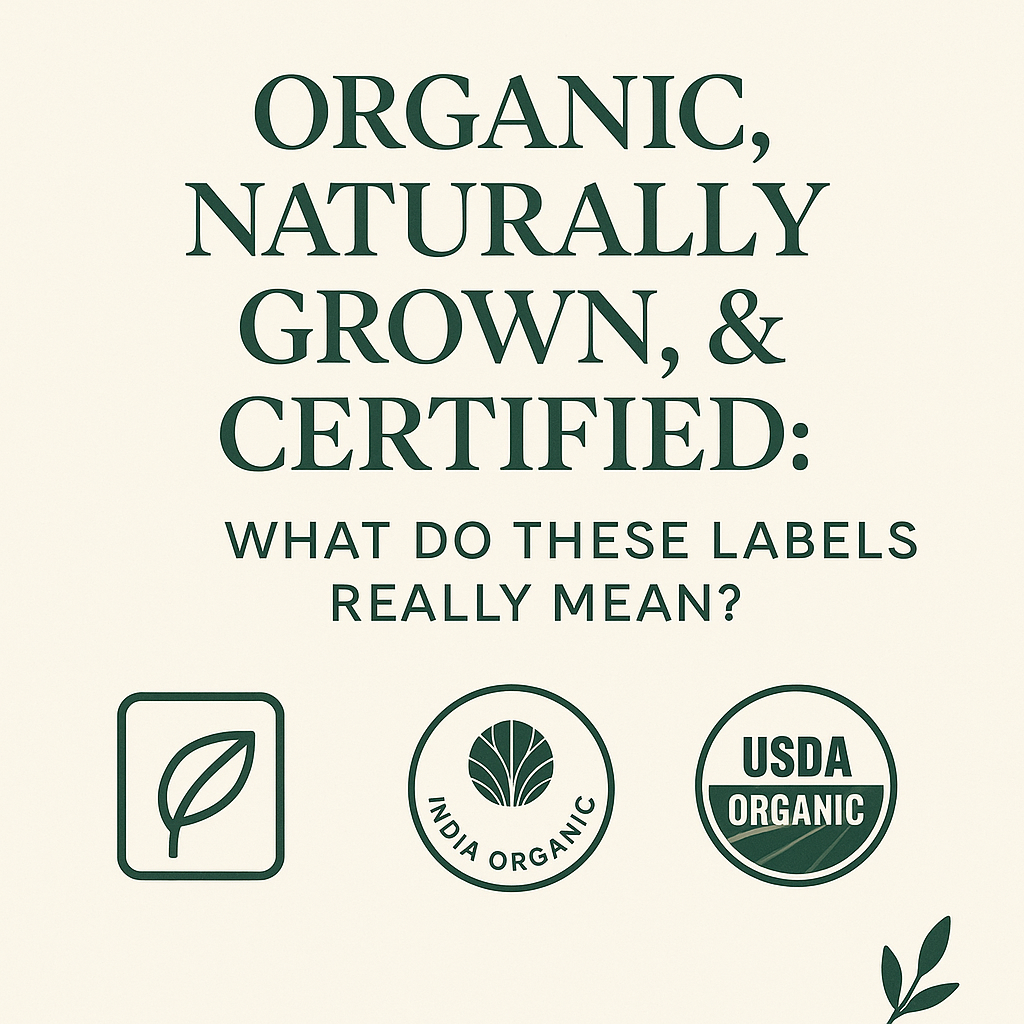
Why Food Labels Can Feel So Confusing
Walk through a store or scroll online and you’ll see words like:
Organic. Naturally grown. Chemical-free. Farm fresh. Pure.
They all sound good — but they don’t all mean the same thing.
Some are legally regulated, some are descriptive, and some are simply marketing language.
Let’s break this down gently and honestly.
1. What Does “Certified Organic” Actually Mean?
When a product is certified organic, it means it follows government-defined standards and has been verified by an independent body.
Organic farming prohibits:
❌ synthetic pesticides
❌ chemical fertilisers
❌ GMOs
❌ artificial ripeners
❌ toxic preservatives
And requires:
✔️ soil health management
✔️ crop rotation
✔️ natural pest control
✔️ traceability from farm to shelf
✔️ regular audits
Organic is not just a claim — it’s a system.
2. APEDA & NPOP — India’s Organic Backbone
APEDA
(APEDA = Agricultural and Processed Food Products Export Development Authority)
APEDA is a Government of India body that oversees organic standards and approves certifying agencies.
It does not certify food directly — it regulates who can certify.
NPOP (National Programme for Organic Production)
This is India’s official organic standard.
NPOP defines:
-
how crops are grown
-
what inputs are allowed
-
how farms are inspected
-
how organic food is processed & labelled
If a product follows NPOP, it may carry the India Organic or Jaivik Bharat logo.
3. India Organic & Jaivik Bharat Logos
If you see these logos on packaged food in India, it means:
✔️ the product follows NPOP standards
✔️ it is certified by an APEDA-approved agency
✔️ the organic claim is legally valid
If a product says “organic” without these logos, it is not legally certified (unless it is sold under PGS-India — explained next).
🌱 4. PGS-India — Organic for Small Farmers
PGS (Participatory Guarantee System) is designed for small and community farmers.
Instead of expensive third-party audits, farmers certify each other under government guidelines.
PGS products can also carry the Jaivik Bharat logo.
This makes organic farming more inclusive — especially for local and traditional growers.
5. USDA Organic, EU Organic & Global Certifications
Products sold internationally may carry:
-
USDA Organic (USA)
-
EU Organic Leaf (Europe)
-
ACO Organic (Australia)
These standards are different but equivalent, not necessarily “better” than Indian organic standards.
Indian NPOP certification is recognised globally.
🌱 6. So… What Does “Naturally Grown” Mean?
This is where confusion begins.
“Naturally grown” is NOT a legally regulated term.
It usually means:
✔️ traditional farming practices
✔️ little or no chemical use
✔️ compost, cow dung, natural inputs
✔️ seasonal cultivation
Many farmers genuinely grow food this way — especially small and local ones.
But…
⚠️ 7. The Important Truth About “Naturally Grown”
Unlike organic, naturally grown:
❌ has no official definition
❌ has no certification requirement
❌ has no audits or inspections
❌ has no traceability guarantee
Anyone can legally use the term — even if chemicals are occasionally used.
That doesn’t mean it’s bad.
It means it’s based on trust, not verification.
🌾 8. Naturally Grown vs Certified Organic
| Aspect | Naturally Grown | Certified Organic |
|---|---|---|
| Legal definition | ❌ No | ✔️ Yes |
| Certification | ❌ No | ✔️ Mandatory |
| Audits | ❌ No | ✔️ Regular |
| Input rules | Undefined | Strict |
| Traceability | ❌ No | ✔️ Yes |
| Cost to farmer | Low | Higher |
Both have value — they are just not the same thing.
. How Should You Choose as a Consumer?
There is no one “right” choice — only an informed one.
✔️ Buying directly from trusted local farmers?
→ Naturally grown may be perfectly fine.
✔️ Buying packaged food, oils, grains, baby food, exports?
→ Certified organic is safer.
✔️ Unsure of claims?
→ Look for certification logos + numbers.
💚 The Urban Organic Life Way
At Urban Organic Life, we believe customers deserve clarity, not confusion.
That’s why we:
-
clearly label certified organic products
-
honestly disclose when something is naturally grown
-
work closely with farmers
-
prioritise transparency over buzzwords
Because food choices should be informed, not intimidating.
✨ In Simple Words
-
Naturally grown = good intention, trust-based
-
Certified organic = verified, audited, regulated
Both support better farming.
But they are not interchangeable.
Choose what aligns with your values, your budget, and your trust —
and most importantly, choose consciously.